
1. Introduction
The aim of this guideline is to provide evidence-based recommendations in the management of primary postpartum haemorrhage (PPH). This is the commonest direct cause of maternal death globally and in Sri Lanka. The objective of this guideline is to ensure anticipation, prevention, early detection and timely and appropriate management of PPH.
2. Definition
For the purpose of this guideline PPH is defined as blood loss of 500 ml or more from the genital tract within 24 hours of the birth of a baby. Blood loss of over 1000 ml is defined as major PPH. Major can be further sub-divided into moderate (1001-2000 ml) and severe >2000 ml.
In a woman with lower body mass (e.g. <60 Kg) a lower level of loss of blood volume may be clinically significant.
Since blood volume differs between persons, blood loss must be individualized.
The loss of 40% or more of the blood volume is life threatening and will be defined as a massive obstetric haemorrhage. Blood volume = 100ml/Kg
Irrespective of the loss of blood volume, appearance of cardiovascular instability (i.e. tachypnea, altered mental status, tachycardia and hypotension) signifies possibility of major obstetric hemorrhage.
3. Prevention of Postpartum Haemorrhage
Active management of the third stage of labour is the cornerstone of prevention of primary PPH.
Postpartum care observations should be recorded on a MEOWS chart for early detection of patients needing further care.
Minimizing risk:
- Anemia in pregnancy should be corrected during antenatal period. Patients who are decided for delivery advise to have minimum level of haemoglobin of 10 g/dL.
- Maintain adequate hydration during labor in order to have physiological maximum circulatory volume.
PPH occurs most often in women without risk factors. Therefore, the blood group and level of haemoglobin of every woman who goes into labor must be known.
a Consultant Obstetrician and Gynaecologist, Colombo North Teaching Hospital, Ragama, Sri Lanka
b Consultant Obstetrician and Gynaecologist, Castle Street Hospital for Women, Colombo 8, Sri Lanka
c Professor in Obstetrics and Gynaecology, Department of Obstetrics and Gynaecology, University of Colombo, Sri Lanka
d Consultant Obstetrician and Gynaecologist, Colombo North Teaching Hospital, Ragama, Sri Lanka
e Consultant Obstetrician and Gynaecologist, Colombo North Teaching Hospital, Ragama, Sri Lanka
Women with known risk factors associated with PPH, as listed in Box 1. Should be advised to deliver in a specialist obstetric unit under extra vigilance. Of these, Abruptio placenta, Placenta praevia and Morbidly adherent placentae are especially at higher risk.
Box. 1 Risk Factors for PPH
Risks existing prior to labour
- Grand Multi parity
- Previous PPH
- Uterine over distension e.g. multiple pregnancy, etc.
- Large baby (>4 kg)
- Chorio-amnionitis
- Dengue infection
Risk factors during Labor
- Failure to progress in second stage of labor
- Prolong 3rd stage of labor
- Retained placenta
Good practices:
- All women under-going labor preferably should have a large bore cannula.
- Any woman with at least one risk factor should have intravenous access established with either a 16 or Gray cannula and a sample of blood taken and preserved for grouping and DT and or save.
- Attempt to estimate and record blood loss in all deliveries.
- Check the state of the uterine fundus as a routine post-delivery observation practice.
4. Management of Primary PPH
In Sri Lanka usual practice has been to commence treatment when there is continuing bleeding despite uterine massage irrespective of the amount of blood lost.
It is recommended that this practice be continued.
4.1. Identification of severity of haemorrhage
Clinicians should be aware that the visual estimation of post partum blood loss is inaccurate and that clinical signs and symptoms should be included in the assessment of PPH.
Shock index (SI)- (Heart rate/Systolic Blood Pressure) as an effective predictor for PPH SI <0.9 provides reassurance, whereas SI ≥1.7 indicates a need for urgent attention in haemorrhage. (BJOG. 2015; 122(2): 268-75. doi: 10.1111/1471-0528.13206.)
Call for help:
Who should be informed when the woman presents with PPH?
- Early involvement of appropriate senior staff is fundamental to the management of PPH.
- Any significant postpartum bleeding should be informed to the highest level of obstetric team. This should be done by the attending Medical Officer.
However, in the absence of a MO any staff member could inform.
- Even the situation is manageable by middle grade medical staff information to the highest level is essential.
- In minor PPH, the first line staff should be alerted.
- In major PPH, the following members should be alerted at the same time with effective communication.
a. The obstetric middle grade,
b. The anesthetic middle grade; Where available, the early involvement of the anesthetic team, even while the patient is still in the labor room is recommended.
c. Inform theatre
d. Alert MO blood bank
e. Alert Consultant Obstetrician
f. Alert Consultant Anaesthetist
g. Transfusion medicine specialist / Haematologist
h. Alert the head of the institution
In a hospital clear instruction to telephone operator how to convey such message should be given by the administration to alert the stipulated staff as stated above. The telephone operator should document the list of staff informed and submit it to the ward to be attached to the Bed Head Ticket.
Communication with the mother
Maintain a calm atmosphere.
Keep the mother (and labor companion/family) informed and reassure the mother regularly where feasible.
4.2. Documentation: It is important to record: to be done later once the mother is stable
- The staff attended and the time the sequence of events.
- The details of interventions, administration of pharmacological agents, fluid and blood products given, surgical interventions.
- The condition of the mother throughout the different steps.
- It is recommended that one member of staff is delegated specifically for this task and to coordinate with other relevant disciplines.
4.2.1. Measures for minor PPH: Blood loss 500-1000ml without clinical shock
- Assess, monitor and record: general condition, estimated blood loss, pulse, blood pressure and respiratory rate (every 15 minutes)
- Ensure there is intravenous access with a wide (14-16 G) bore cannulae.
- Send blood for cross matching and baseline full blood count.
- Start Ringer’s lactate (Hartmann’s)/ Normal saline.
- Identify the cause of bleeding.
- Keep the woman warm.
- Pay attention to the temperature of labor room, operating theatre, intravenous fluids, blood, blood products and fluids used for lavage. Hypothermia is known to promote coagulopathy.
- Maintain MEOWS chart.
4.2.2. PPH of more than blood loss 1000ml/ active bleeding/ signs of shock
- Recognize this as a life-threatening emergency. Quick action without delay saves life.
- Major PPH once suspected should be managed in adequately equipped operating theatre with all resuscitation facilities.
- Early involvement of appropriate senior staff is fundamental for the management of major PPH. Following members of staff should be called and summoned to attend. Theatre in charge Nursing officer, Consultant Obstetrician, Consultant Anaesthetist, Consultant Transfusion specialist, Consultant Haematologist, Overseer of minor staff.
- Team work, Resuscitation, Monitoring, Controlling bleeding pharmacologically and surgically, taking general measures, all should go hand in hand because all are equally important.
- Attempts must be made to prevent or minimize dilutional coagulopathy, hypothermia, and metabolic acidosis from the beginning of resuscitation protocol.
Resuscitation
- ABCDE approach.
- Clear airway. High flow oxygen to keep SPO2> 95%, attach oximeter probe.
- Intubate, ventilate – if abnormal breathing, unconscious, unresponsive.
- Insert two 14-16 g cannulae, draw 20 ml blood for grouping, DT, FBC, BU, Electrolytes, APTT, PT/INR, ROTEM, S. Fibrinogen.
- Request 6 U blood, Cryoprecipitate 20 U, FFP 4 U, platelets 1 adult dose.
- Inform blood bank to activate massive haemorrhage protocol.
- Monitor BP, ECG, AVPU, CBS, UOP, CVP
- Transfuse blood as soon as possible. Minimise crystalloid, replace blood loss with blood. In emergency use on the availability of specific
blood. O-ve O+ve group-specific uncross matched cross-matched.
- Warm patient with forced air warmer, Warm fluids/blood using rapid warmer infuser. Or normal blood warmer.
- Control bleedingmedical/ physical manoeuvres and surgical.
- Get ROTEM result within 5-10 min. Replace as indicated by ROTEM.
- If ROTEM not available start giving shock packs – 4:4: I adult dose of platelets.
- Due consideration must be given to keeping transport facilities available to obtain blood and blood products from another institution.
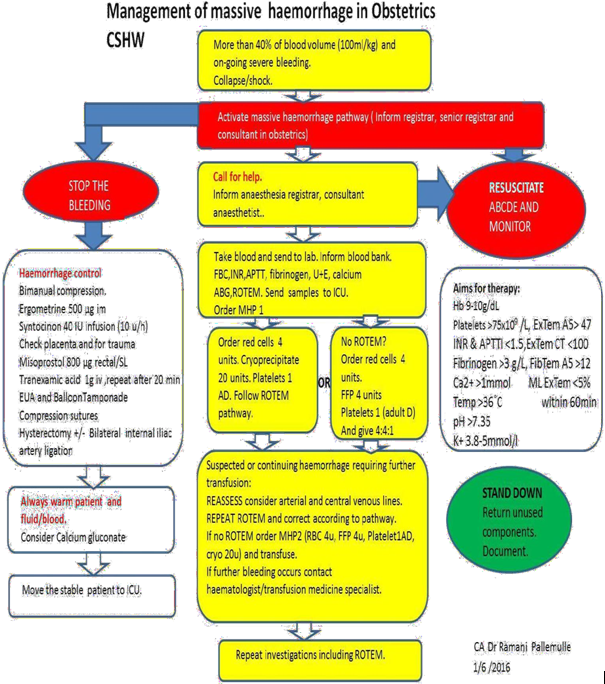
4.5.1. Establish a cause for the bleeding – Four T’s, Tone, Tissue, Trauma, Thrombin
4.5.3.1. Management of Atonic Haemorrhage
- Start uterine massage by ‘rubbing up the fundus’.
- Clear the cervical canal and vagina of blood clots by vaginal examination.
- Hypothermia is a particular risk in the theatre environment. Measures must be taken to minimize the loss of heat from the woman.
- Cochrane review 25th April 2018 conclude Ergometrine plus Oxytocin combination, misoprostol plus oxytocin combination is more effective in preventing PPH [500ml than using current standard of Oxytocin alone.
- Administer either Ergometrine maleate 0.5 mg slow IV or methyl Ergometrine 0.2 mg slow IV or oxytocin 5 IU IV and start an infusion of 40 IU of Oxytocin in 500 ml of Hartmann’s / Normal Saline solution at 125 ml per hour via an infusion pump.
- Ergometrine can be repeated in every 2 hours up to 3 doses.
- Start bimanual compression of uterus.
- If the bleeding fails to abate completely in 5-10 minutes administer/repeat Ergometrine 0.5mg IV. (Level IV – SLCOG consensus) (WHO 2000 publication Managing Complications in Pregnancy and Child Birth Page 5-28, Table 1, Can repeat Ergometrine for the first time in 15 Minutes up to four doses thereafter in four hours apart.).
- At the same time, administer Tranexamic acid 1 g by slow IV over 10 minutes. Maximum benefit is achieved if given within 30 minutes. This dose may be repeated after 30 minutes if necessary and later if bleeding recommences.
- If the bleeding fails to abate completely in a further 10 minutes administer misoprostol 1000mic per rectally or sublingually.
- If the bleeding fails to abate completely for above measures proceed to uterine balloon tamponade. Compression of Aorta just above the bifurcation helps to minimize the loss until other measures are readily available.
- For details of the method of balloon tamponade. Bakri Catheter.
- Any institution undertaking delivery of pregnant women should have members trained for insertion of tamponade catheter.
Before transferring the patient it’s important to do the following;
- Large bore cannula inserted and IV Crystalloids (NS/RL) or blood running
- Oxygen 10-15L/ min to keep SpO2 > 95%
- IV Tranexamic acid 1g given
- Temporizing measures such as manual aortic compression and sand bags to compress the uterus are recommended while the patient is in transit
- Inform the receiving institution/Ward / ICU
- After the balloon is inserted and the vagina packed (to keep the balloon in the uterus), the woman’s vital parameters and the level of the fundus must be monitored carefully. Where these indicate the woman is continuing to bleed.
- Prior to laparotomy the woman must be examined under anesthesia for tears in the genital tract.
- The surgical measures would depend on the woman's condition. “Too little too late” is the main contributor to mortality in PPH. First hour known as the golden hour in decision making. Surgical measures include brace (compression) sutures, uterine de-vascularization, Haemostatic mattress sutures to bleeding sinusoids, Box sutures to include the bleeding lower segment in Placenta Previa, internal iliac ligation and Hysterectomy.
- The “sandwich technique” involves inserting a balloon tamponade after the application of brace sutures.
Resort to hysterectomy without delay if other measures appear to be failing.
4.5.3.2. Management of Traumatic PPH
Manage only in theatre under suitable anaesthesia and exposure
1. Exclude high vaginal and cervical tears before suturing episiotomy.
2. Examine for paravaginal and broad ligament haematomata with a combined per vaginal and per rectal examination.
3. Early use of USS recommended for identification of internal bleeding.
4. Paravaginal hematomas of more than 5 cm diameter will usually require surgical evacuation. A bleeding point is usually present and must be looked for. In cases where it is difficult to control bleeding, a Foley catheter with its balloon inflated may be left in the cavity. Packing of the vagina may also be useful.
5. Cervical tears must be identified by systematic inspection of the cervix using Green- Armytage forceps and sutured.
6. In case of multiple tears with venous oozing, it may be better to insert a balloon catheter into the vagina or to pack the vagina with moistened vaginal packs than to try to suture all the tears.
7. Vasopressin soaked pack (1 vial: 200ml diluted saline).
Rupture of the uterus
- Rupture of the uterus must be suspected when the general condition is deteriorating out of proportion to the visible blood loss and there is continuing bleeding in the presence of a contracted uterus.
- This is particularly so in a woman with a scarred uterus.
4.5.3.3. Coagulopathy causing PPH
- This could be due to coagulopathy following
Death in utero, Abruptio placentae, severe Pre- Eclampsia, HELLP syndrome, Sepsis, Amniotic fluid embolism, Acute fatty liver, primary immune Thrombocytopenia, Von Willebrand’s disease etc.
- It could also be due to suboptimal management of the PPH. • Early summoning of a Haematologist and Transfusion medicine specialist for management will be important in this situation.
- Where available, Thromboelastometry should be used.
Special Situations
- Tranexamic acid 1 g IV can be given for high risk mothers who undergo caesarean section in addition to Syntocinon.
- When there is placenta praevia after a previous caesarean section, it is advisable to look for specific USS features of accreta /percreta.
- The timing and location for delivery should be chosen to facilitate consultant presence and access to intensive care and other supportive care. Eg Rapid transfusion facilities, availability of blood and blood products.
- It is important to educate the relatives about the risks and the need for critical care post operatively and consent obtained.
4.5.4. Debriefing
- It is possible that a major PPH could result in significant psychological morbidity.
- This could be minimized by timely debriefing of the patient and her family, preferably by the Consultant.
- This should be done immediately after the event, before discharge or at the postnatal visit or at any time as requested by her or the family.