
Introduction
Obstetric haemorrhage remains a leading cause of direct maternal deaths in Sri Lanka, accounting for 15.4% of total maternal deaths in 20201. Eventhough a large majority of patients with obstetric haemorrhage survive uneventfully with timely interventions, it remains an important cause of severe maternal morbidity.
In 2022, the prevalence of anaemia among pregnant women in Sri Lanka was 29.1%2. A significant proportion of pregnant women with anaemia may require blood transfusion if it is not addressed in a timely manner. Transfusion services in Sri Lanka are rapidly improving, with all blood components prepared with 100% volunteer donations, which are mandatorily tested for HIV 1 and 2, Hepatitis B, Hepatitis C, Syphilis and Malaria.
Strategies to minimise the requirement for transfusion
Optimisation of haemoglobin during the antenatal period
Diagnosis
All pregnant women should be screened for anaemia at the booking visit and 28 weeks. Anaemia in pregnancy is defined as first-trimester Hb less than 11g/dL, second and third-trimester Hb less than 10.5g/dL, and postpartum Hb less than 10g/dL according to the British Committee for Standards in Haematology3. If the Hb level is less than the relevant thresholds, consider haematinic deficiency once haemoglobin-opathies have been excluded.
Treatment and management
Oral iron should be the preferred first-line treatment for iron deficiency anaemia. Parenteral iron is indicated when oral iron is not tolerated or absorbed, patient compliance is in doubt or if the woman is approaching term when there is insufficient time for oral supple- mentation to be effective. Women should receive information on improving dietary iron intake and the factors affecting the absorption of dietary iron.
Meta-analysis of randomised trials on the antenatal use of iron, with or without folic acid, showed a 50% reduction in the risk of anaemia in the third trimester or at delivery4,5. Parenteral iron therapy offers a shorter duration of treatment and a quicker response but is more invasive. Intravenous iron preparation should be administered with all resuscitation facilities available immediately, as severe allergic reactions are possible. Anaemia not due to haematinic deficiency should be managed in close conjunction with a haematologist and transfusion physician.
- Strategies to minimise blood loss at delivery
Women at high risk of haemorrhage should be delivered in a hospital with facilities to manage massive bleeding. Active management of the third stage of labour is recommended to reduce postpartum blood loss.
General principles of blood transfusion
Consent
Valid informed consent should be obtained where possible before blood transfusion. In case of an emergency, where it is not feasible to get consent prior to transfusion, transfusions should not be delayed, but information on blood transfusion should be provided retrospectively.
Where transfusion of all or a specific blood component is refused, or an advanced directive exists, detailed counselling should be arranged with a transfusion physician where available. This should be documented in the patient’s clinical records and communicated to all relevant healthcare professionals. Following detailed counselling, should the patient not consent for transfusion of blood and blood products, legal guidance should be sought.
Requirements for group and screen samples and cross-matching
All women should have their blood group and red cell antibody status checked at booking and 28 weeks gestation. If red cell antibodies are detected in the booking sample, further testing of maternal blood should be done to determine the specificity and the titre of antibody/antibodies detected and to assess the likelihood of haemolytic disease of the foetus and newborn.
Group and screen samples used for the provision of blood in pregnancy should be less than 3 days old. This should accompany a separate sample for blood group confirmation if the blood group has not been done before. In a woman at high risk of emergency transfusion, e.g., placenta previa, with no clinically significant alloantibodies, group and screen samples should be sent once a week to exclude or to identify any new antibody formation and to keep blood available if necessary. Close liaison with the transfusion physician/team is essential.
Blood product specifications in pregnancy and puerperium
ABO and RhD identical or compatible red cell units should be transfused. If clinically significant red cell antibodies are present, blood negative for the relevant red cell antigen should be cross-matched for transfusion. Where complex antibodies or rare red cell phenotypes are identified, provision of compatible blood may take time, and when transfusions are needed in such instances, inform the transfusion laboratory in advance to avoid potential delays in the provision of blood. All patients receiving transfusions should be closely monitored throughout the transfusion to identify signs of transfusion reactions and adverse events early and act promptly.
Intraoperative cell salvage
Intraoperative cell salvage could be considered in patients who are expected to have a blood loss of more than 500ml or more than 10% of the patient’s estimated blood volume if facilities are available6. However, such facilities are currently unavailable in Sri Lanka.
Management of obstetric haemorrhage with blood components
Clinicians should familiarise themselves with the existing guidelines on the management of PPH and protocols for managing major obstetric haemorrhage, including the mechanical strategies employed to reduce postpartum blood loss7.
When should red cells be used?
The decision to transfuse should be made on clinical and haematological grounds. Although the aim of blood transfusion in a bleeding patient is to maintain Hb more than 8g/dL, patients with acute haemorrhage can have normal Hb and clinical evaluation in this situation is extremely important.
In an emergency where the patient’s blood group is unknown, group O RhD-negative red cells should be given until the blood group is established and then switch to group-specific red cells. In case of a severe haemorrhage, if there is a history of clinically significant red cell antibodies being present, close liaison with the transfusion physician is essential to avoid delay in transfusion. Once bleeding is controlled, restoring Hb to physiological levels with red cell transfusions is not indicated8.
In what circumstances should fresh frozen plasma (FFP) and cryoprecipitate be used?
When available, point-of-care testing-guided FFP and cryoprecipitate transfusions are preferable to optimise haemostatic management9. If results of point-of-care or haemostatic testing are unavailable and haemorrhage continues, FFP at a dose of 12-15 ml/kg should be administered for every six units of red cell concentrates (RCC)5. Early use of FFP should be considered for conditions with a suspected coagulopathy, such as placental abruption or amniotic fluid embolism, or where detection of PPH has been delayed10.
If the haemorrhage is ongoing, subsequent FFP transfusion should be guided by the results of clotting tests aiming to maintain prothrombin time (PT) and activated partial thromboplastin time (APTT) ratios at less than 1.5 times normal8. It is essential that regular full blood counts and coagulation screens (PT, APTT and fibrinogen) are performed during the bleeding episode. The drawbacks of early FFP are that the majority of women with PPH will have normal coagulation at the time of FFP administration and that it is associated with an increased risk of transfusion- associated circulatory overload (TACO) and trans- fusion-related acute lung injury (TRALI). FFP results in a relatively small increment in fibrinogen level10,11.
Cryoprecipitate at a standard dose of 10 units should be administered relatively early in major obstetric haemorrhage. Subsequent cryoprecipitate transfusion should be guided by fibrinogen results, aiming to keep levels above 2g/l. RCTs do not support the early unselected use of fibrinogen replacement therapy, and administering fibrinogen supplementation to women with PPH who have fibrinogen levels of >2 g/l is unlikely to have added benefit8,12,13.
FFP should ideally be of the same ABO group as the recipient. If unavailable, FFP of a compatible ABO group is acceptable. The blood group of cryoprecipitate is not considered in the local context, considering the production method.
Clinicians should be aware that these blood components must be ordered as soon as a need for them is anticipated, as there will always be a short delay in supply because of the need for thawing and reconstituting.
When should platelets be used?
Aim to maintain the platelet count above 50×109/l in an acutely bleeding patient. A platelet transfusion trigger of 75×109/l is recommended to provide a margin of safety. If results of point-of-care testing or haemostatic testing are not available and haemorrhage is continuing, four units of platelet concentrates should be administered after eight or more units of red cell concentrates14. The platelets should be ABO group identical or compatible. To avoid the development of anti-D antibodies, RhD-negative platelet concentrates should be given where possible to RhD-negative women of childbearing potential.
Platelets may not be readily available in some hospitals; therefore, their need should be anticipated, and good communication with the transfusion team should be maintained. The platelet count should not be allowed to fall below 50×109/l in the acutely bleeding patient, as this represents the critical level for haemostasis. Such a low platelet count may be anticipated when approximately two blood volumes have been replaced by fluid or blood components. A platelet transfusion trigger of 75×109/l is recommended in a patient with ongoing bleeding to provide a margin of safety.
If RhD-positive platelets are transfused to a RhD- negative woman of childbearing potential, anti-D immunoglobulin should be administered. A dose of 250 iu anti-D immunoglobulin is sufficient to cover 5 adult therapeutic doses of platelets given within a 6-week period. This may be given subcutaneously to minimise bruising and haematomas in thrombocytopenic women.
How should intrapartum anaemia be managed?
In anaemic women who are not actively bleeding, if the Hb is less than 8g/dL in labour or in the immediate postpartum period, the decision to transfuse should be made according to the individual’s medical history and symptoms. Where transfusion is indicated, transfusion of a single unit of red cell concentrate should be followed by clinical reassessment to determine the need for further transfusions.
How should women with postpartum anaemia be managed in the postnatal period?
If the Hb is more than 7g/dL in the postnatal period, where there is no ongoing or threat of bleeding, the decision to transfuse should be made on an informed individual basis. The risk of RBC alloimmunisation and the potential clinical impact should be considered when balancing the risks and benefits of RBC transfusion. Non-transfusion therapies, such as iron, should be considered as a part of the treatment of postpartum anaemia.
How should women who decline blood products be managed?
Hb should be optimised prior to delivery to prevent avoidable anaemia. Consent/refusal of blood components or other transfusion-sparing techniques should be discussed in detail and clearly documented during the antenatal period. The use of pharmacological, mechanical and surgical procedures to avert the use of banked blood and blood components should be considered early. Medicolegally, withholding blood products in life-saving situations is not permitted.
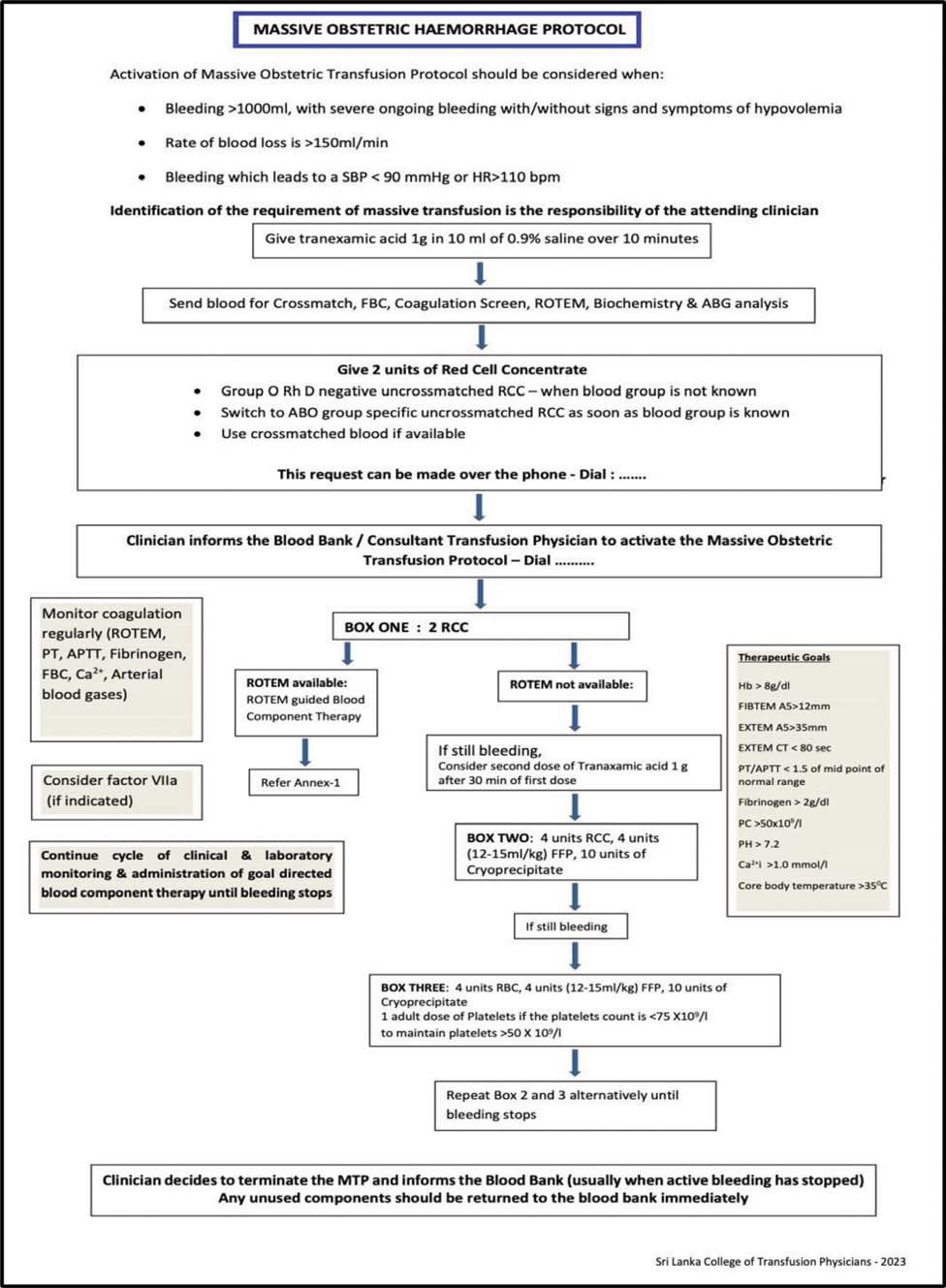
Appendix 1. Massive obstetric haemorrhage protocol
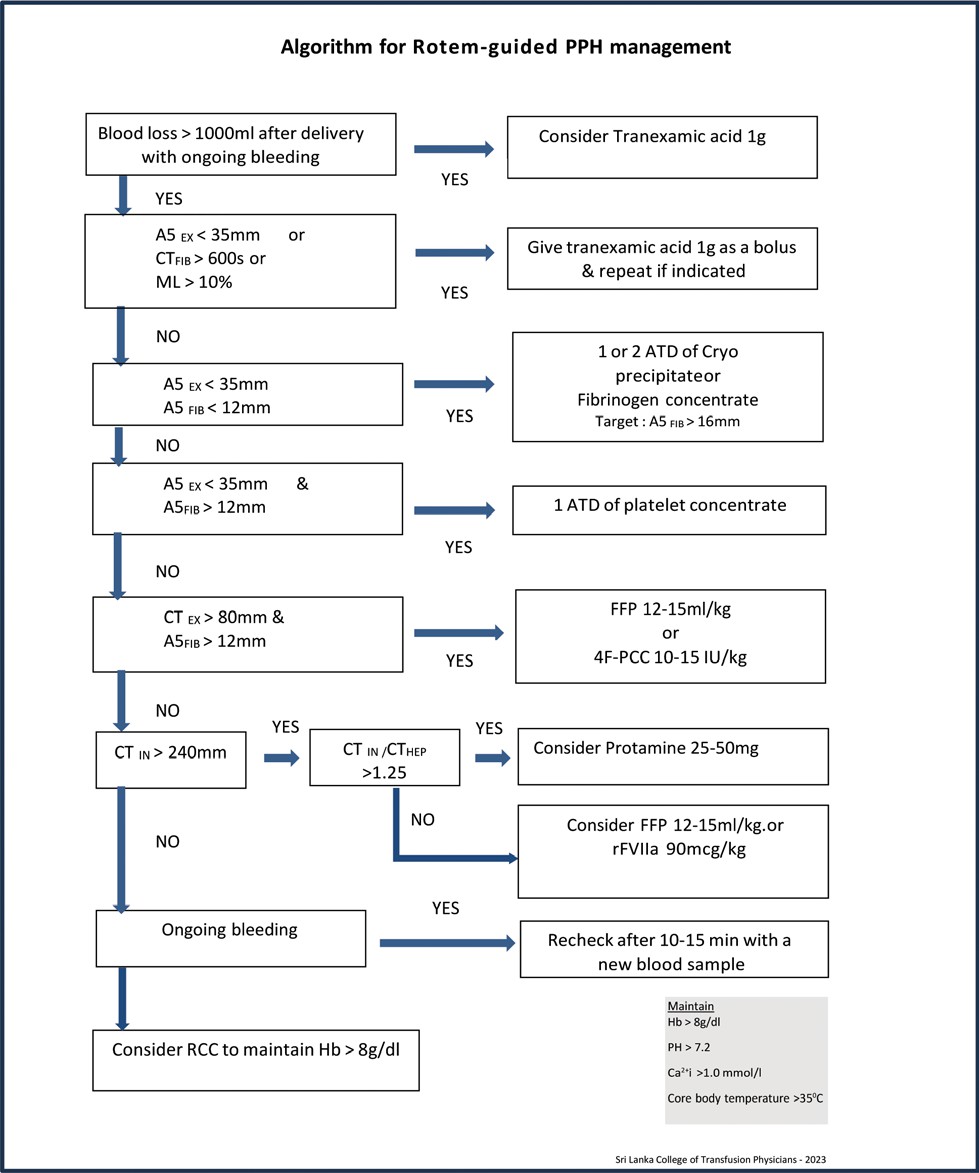
Appendix 2. Algorithm for Rotem-guided PPH management
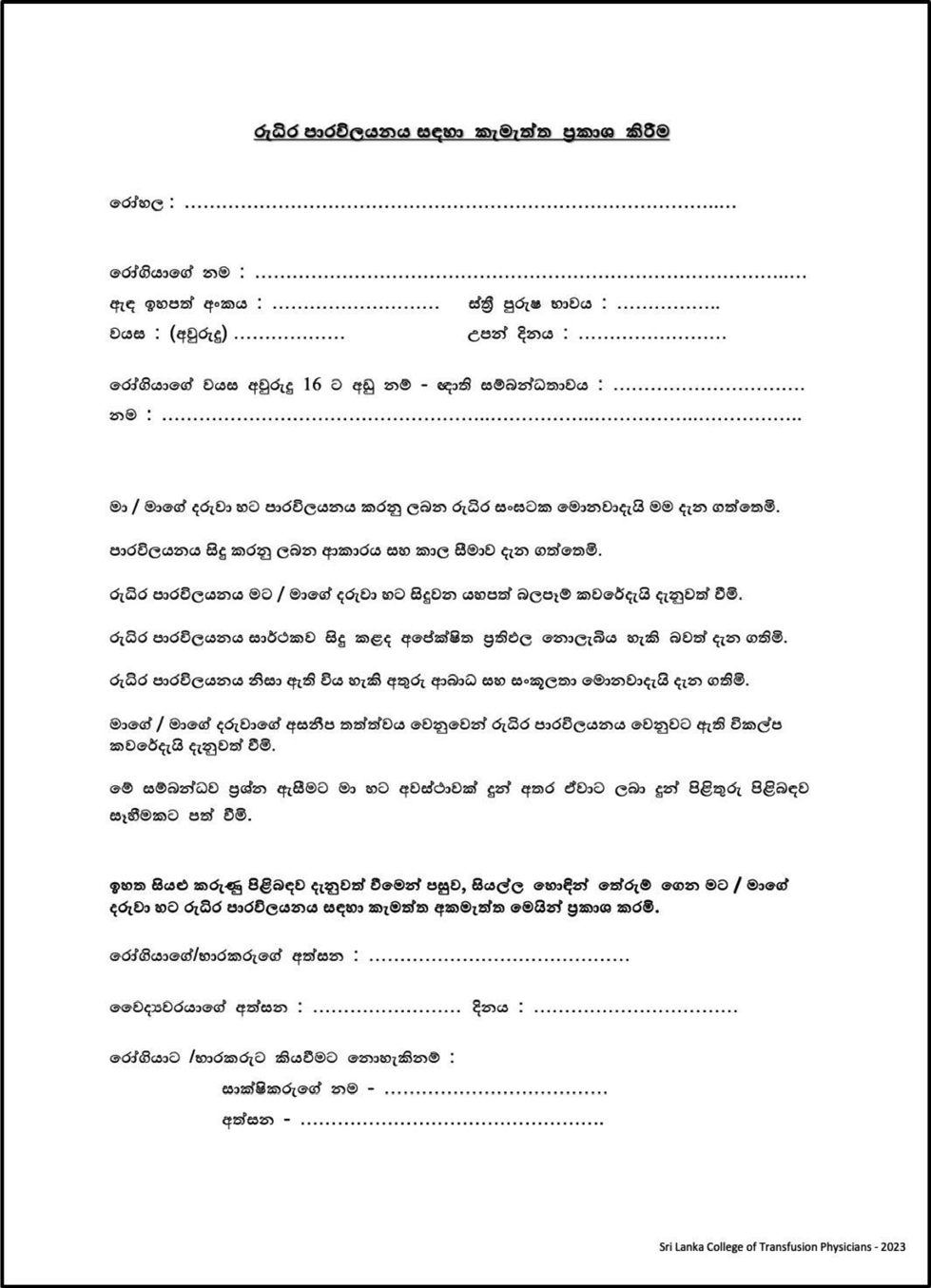
Appendix 3. Sample consent form for transfusion of blood and blood components
References
- Annual Health Bulletin 2020. Ministry of Health, Sri Lanka.
- Amarasinghe GS, Agampodi TC, Mendis V, Malawanage K, Kappagoda C, Agampodi SB. Prevalence and aetiologies of anaemia among first trimester pregnant women in Sri Lanka; the need for revisiting the current control strategies. BMC Pregnancy Childbirth. 2022; 22(1): 16.
- Pavord S, Daru J, Prasannan N, Robinson S, Stanworth S, Girling J, et al. UK guidelines on the management of iron deficiency in pregnancy. Br J Haematol. 2020; 188(6): 819-30.
- Haider BA, Olofin I, Wang M, Spiegelman D, Ezzati M, Fawzi WW. Anaemia, prenatal iron use, and risk of adverse pregnancy outcomes: systematic review and meta-analysis. BMJ: British Medical Journal. 2013; 346: f3443.
- Royal College of Obstetricians and Gynaecologists. Blood Transfusion in Obstetrics. Green-top Guideline No. 47. London: RCOG; 2015.
- Carroll C, Young F. Intraoperative cell salvage. BJA Educ. 2021; 21(3): 95-101.
- Guidelines for the Blood Transfusion Services in the United Kingdom. www.transfusionguidelines.org.uk
- Stanworth SJ, Dowling K, Curry N, Doughty H, Hunt BJ, Fraser L, et al. Haematological management of major haemorrhage: a British Society for Haematology Guideline. Br J Haematol. 2022; 198(4): 654-67.
- Snegovskikh D, Souza D, Walton Z, Dai F, Rachler R, Garay A, et al. Point-of-care viscoelastic testing improves the outcome of pregnancies complicated by severe postpartum hemorrhage. J Clin Anesth. 2018; 44: 50-6.
- Mavrides E, Allard S, Chandraharan E, Collins P, Green L, Hunt BJ, Riris S, Thomson AJ on behalf of the Royal College of Obstetricians and Gynaecologists. Prevention and management of post- partum haemorrhage. BJOG 2016; 124: e106-e149.
- McNamara H, Kenyon C, Smith R, Mallaiah S, Barclay P. Four years’ experience of a ROTEM. Anaesthesia. 2019; 74(8): 984-91.
- Collins PW, Cannings-John R, Bruynseels D, Mallaiah S, Dick J, Elton C, et al. Viscoelastometric- guided early fibrinogen concentrate replacement during postpartum haemorrhage: OBS2, a double- blind randomized controlled trial. Br J Anaesth. 2017; 119(3): 411-21.
- Wikkelso AJ, Edwards HM, Afshari A, Stensballe J, Langhoff-Roos J, Albrechtsen C, et al. Pre-emptive treatment with fibrinogen concentrate for postpartum haemorrhage: randomized controlled trial. Br J Anaesth. 2015; 114(4): 623-33.
- Collins P, Abdul-Kadir R, Thachil J, Coagulation SoWsHIiTaHaoDI. Management of coagulopathy associated with postpartum hemorrhage: guidance from the SSC of the ISTH. J Thromb Haemost. 2016; 14(1): 205-10.